by Steve Gordon
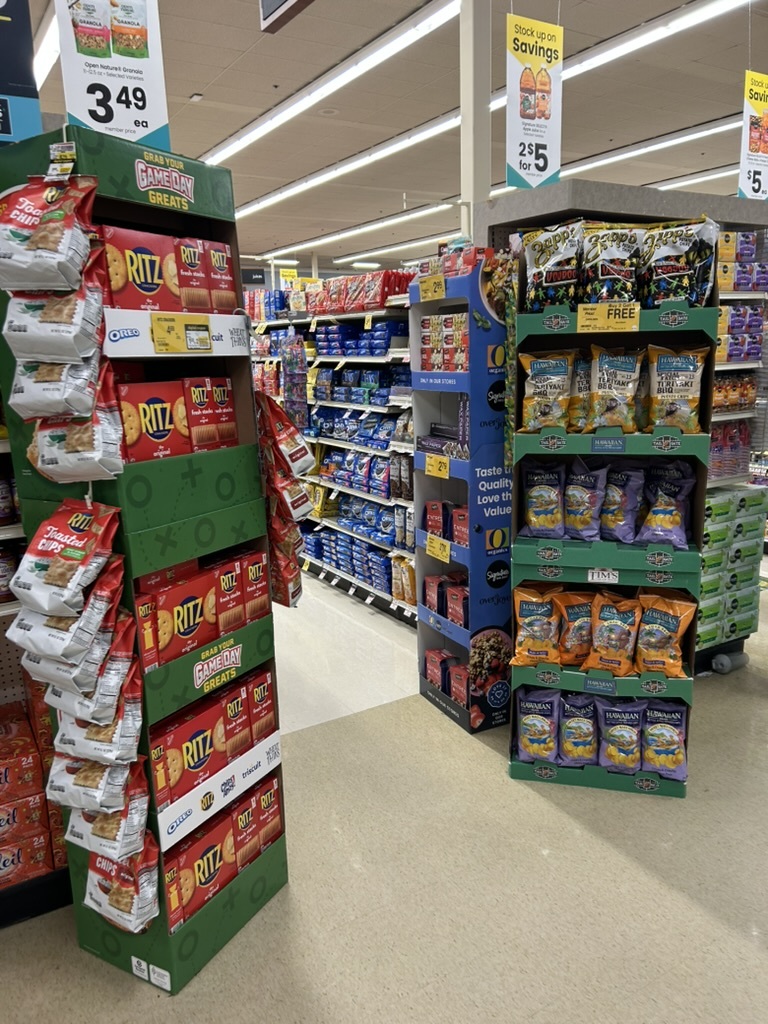
I snapped this photo recently at a local grocery store, and I want you to really look at it. In a single aisle intersection, we have a towering Ritz/Nabisco “Game Day Greats” display stacked nearly to eye level, a Hawaiian/Zapp’s “Tailgate” chip display competing right across from it, an O Organics freestanding unit in the middle distance, and ceiling-hung promotional signage screaming “Stock Up on Savings” from multiple angles, all within about 15 feet of each other. Every one of these displays represents a trade promotion dollar that a brand paid to “own” that space. But who owns it? Nobody. It’s a visual food fight, and the shopper is caught in the crossfire. And to top it all off, you can’t even navigate your cart to get to the cookies and stock up on Oreos without running into something.
This is what happens when retail merchandising analytics operate on a self-imposed lag. Planogram compliance reports, weekly scan data, and periodic store audits were designed for a simpler era, one display, one promotion, one measurement cycle. Today’s reality is three competing FSIs, two seasonal themes, and a store manager with discretion over placement all colliding simultaneously. The brands in this photo are Nabisco, Hawaiian, Zapp’s, and Tim’s, all solid names, but none of them can tell you right now whether their display is driving incremental lift or simply creating noise that cancels out the competition next to it, not to mention the effect those displays are having on the entrenched shelf space behind. Real-time shelf intelligence powered by AI image recognition and display-level sales attribution isn’t a luxury anymore. It’s the only way to know if your trade spend is working or just adding to the chaos. If your organization is ready to make sense of the mess, reach out to me at AlignBiz Consulting we help retail and CPG leaders build AI and data strategies that turn this kind of complexity into a genuine competitive advantage.
About the author:
Steve Gordon is Managing Director of AlignBiz Consulting. He holds a B.S. in Geography and an
M.S. in Planning — disciplines that inform his belief that the most powerful thing you can do with a
complex system is map it accurately. With 35+ years of technology leadership experience spanning
IBM, Teradata, and AWS, he brings deep fluency in the enterprise analytics ecosystem and the
vendor, tool, and buyer dynamics that shape mid-market and enterprise technology decisions. He is
a TDWI speaker and the creator of Technology Cartography™.
www.align-biz.com