DATA & ANALYTICS · ALIGNBIZ INSIGHTS
What’s the Intelligence in Business Intelligence?
Why the most important variable in any data strategy has never been, and still isn’t, the technology
By Steve Gordon · Managing Director, AlignBiz · B.S. Geography, M.S. Planning
When I started in this industry in 1986 at Metaphor Computer Systems, one of the pioneering companies in what we then called Decision Support Systems, the premise was straightforward: help corporations identify trends, understand customer behavior, and make better decisions from their data. The technology was limited. The ambition was not.
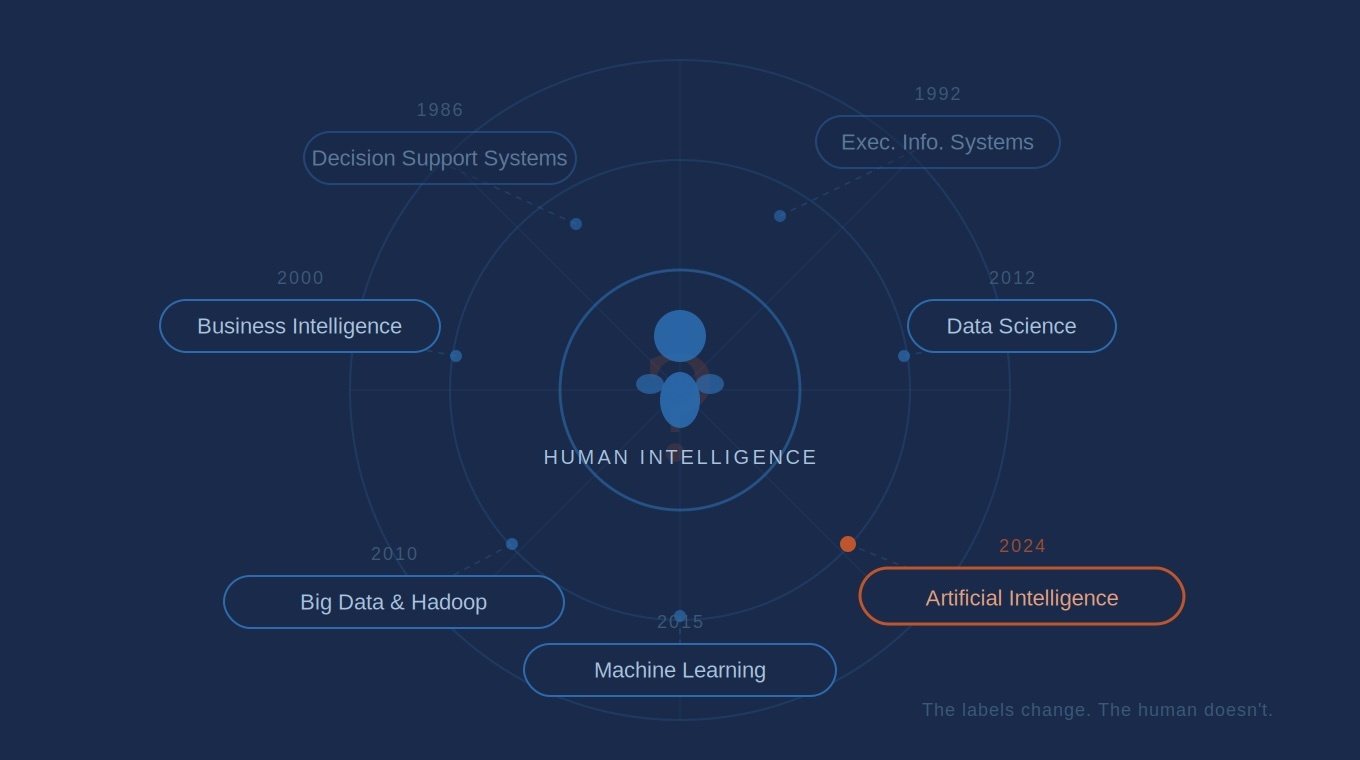
Fast forward nearly 40 years, and we’ve cycled through enough terminology to fill a glossary. Decision Support Systems added Executive Information Systems to become Business Intelligence (BI). BI spawned Data Science. Data Science is now being absorbed into AI. The labels change. The fundamental challenge — getting human beings to ask better questions of their data — has not.
That’s worth sitting with for a moment.
The dictionary definition of intelligence is “the ability to acquire and apply knowledge and skills.” Notice what that refers to: people. Not platforms. Not dashboards. Not data warehouses. People. Which raises an uncomfortable question about an industry that has spent three decades branding itself around the word: where exactly is the intelligence in Business Intelligence?
The Dashboard Trap
Remember Executive Information Systems? The premise was that senior leaders needed their most important business questions pre-answered in a graphical interface — green, yellow, or red — because apparently executives couldn’t be expected to know how to ask for information themselves. We were essentially building analytical training wheels for the C-suite and calling it intelligence.
We never really stopped. We just made the dashboards prettier.
Today’s BI tools are faster, cheaper, and more capable than anything I worked with at Metaphor. The cost of storage has collapsed. The amount of data available to analyze is staggering. You can theoretically ask any question of a modern data warehouse and get an answer. But here’s what hasn’t changed: if you don’t know what question to ask, or why it matters, or what you’ll do with the answer, you still don’t have intelligence. You have a very expensive reporting infrastructure that someone updates every Monday morning.
The Human Lifting
Consider a merchandising manager at a large multi-unit retailer. Every Monday she pulls a report on product movement by store, market, and geography. She compares it to the prior week, the prior month, the prior year. She layers in market basket analysis, maybe some social data. She identifies what moved the needle and what didn’t.
That sounds like BI. But notice what’s happening: she is doing the heavy lifting. She knows which questions matter. She knows which causal factors to look for. She has pattern recognition built from years in the role. Take her out of the equation and you don’t have BI — you have a pile of reports that nobody knows what to do with.
If you don’t know what question to ask, or why it matters, or what you’ll do with the answer, you still don’t have intelligence. You have a very expensive reporting infrastructure that someone updates every Monday morning.
I made this point at a TDWI conference about ten years ago. I asked an audience of roughly 100 senior decision-makers how many had been asked to incorporate social media data into their data warehouse in the past year. Nearly every hand went up. I then asked how many could articulate the specific business question that data was being collected to answer.
The room went quiet. A few people laughed. Most didn’t. No hands went up.
Most of them were doing it because it seemed like the thing to do. Hadoop was the hot technology. Social data was the hot data type. Nobody wanted to be the one who hadn’t done it. I called it lemming behavior at the time, an entire industry heading toward the cliff because the herd was moving that direction. Only a handful of people in that room had stepped back and asked the most basic intelligence question: why?
And Now We Have AI
That was ten years ago. The technology has changed dramatically. The behavior has not.
Today the same dynamic is playing out with AI. Every vendor has an AI story. Every boardroom has an AI mandate. The venture community has poured billions into the space, and the market is responding with exactly the enthusiasm it always does when a new category emerges — more tools, more platforms, more dashboards with AI badges on them.
And the same fundamental question applies before any of this is useful; someone must know what problem they’re trying to solve. Someone must structure the data, define the context, design the process, and ask the right question. Machine learning doesn’t eliminate the need for human intelligence — it amplifies the consequences of its absence. A model trained on the wrong question at scale produces wrong answers at scale, faster than any system in history.
Machine learning doesn’t eliminate the need for human intelligence — it amplifies the consequences of its absence.
The organizations that will get real value from AI are not the ones with the most sophisticated tools. They’re the ones with people who understand their business deeply enough to know what to ask of those tools — and experienced enough to know when the answer they’re getting doesn’t make sense.
That has always been the intelligence in Business Intelligence. It was true in 1986. It’s true today. The tools are different. The requirement is not.
That gap, between data capability and business intelligence, is exactly where we work.
About the Author
Steve Gordon is the Managing Director of AlignBiz. He began his career in 1986 at Metaphor, one of the original Decision Support Systems companies, and has spent nearly four decades at the intersection of enterprise technology, data and analytics strategy, and partner ecosystems — spanning IBM, Teradata, AWS, and independent consulting. A TDWI speaker with a B.S. in Geography and an M.S. in Planning, Steve is the creator of Technology Cartography™, AlignBiz’s proprietary methodology for mapping technology investments across the full enterprise landscape.
steve@align-biz.com