The Loyalty Program Is a Lie And Grocery Stores Know It
When nearly everything in the store is on “member pricing,” what exactly is the regular price and who is it for?
By Steve Gordon · Managing Director, AlignBiz
I was at my local Safeway recently, doing what I apparently have to do now to buy groceries at a reasonable price: standing in the aisle, opening an app on my phone, scanning a UPC code, waiting for a “digital coupon” to load, hoping the system actually registers it when I type my phone number at the checkout kiosk.
It didn’t work. Again. Exhibit A shows how this was really applied.
I stood there long enough to count the number of items in my cart that carried a “member price.” It was most of them. Which got me thinking: if nearly everything in the store is discounted for members, what exactly is the regular price? And who is it for?
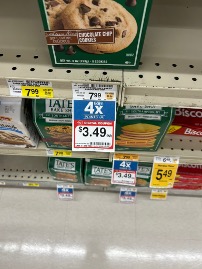
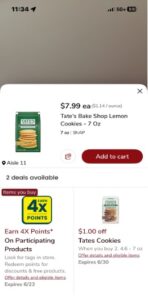
Exhibit A: Tate’s Bake Shop cookies at Safeway $3.49 on the scannable digital shelf tag (above), $7.99 in the app (below). The system designed to deliver the discount can’t agree with itself on the price.
The Original Deal
Grocery loyalty programs were invented with a clear value proposition. Customers hand over their purchase data, what they buy, how often, in what combinations and in exchange they get lower prices. The retailer gets a goldmine of behavioral intelligence: basket analysis, churn prediction, promotional response modeling, supplier negotiation leverage. The customer gets a few cents off cereal.
That was the deal. Data for discounts.
I know this intimately. I spent years inside the retail analytics world at IBM and Teradata, building the very systems that were supposed to make this data meaningful. The promise was real. In theory, a grocery chain with a well-run loyalty program could tell you which customers were about to defect to a competitor, which promotional offers would move the needle for which household segments, which products traveled together in the basket in ways suppliers hadn’t anticipated. That intelligence had genuine value.
What Happened
Here’s the problem: most grocery chains never actually used it that way. Or they did once, then stopped. Or the data team got cut. Or the platform vendor changed. Or the insights never made it from the analytics team to the merchandising team to the store floor.
What remained stripped of its analytical purpose is pure theater.
The “member price” is now just the price. The “regular price” is a fiction maintained to make the discount feel like a reward. And the loyalty program, rather than generating customer intelligence, has become a mechanism for gatekeeping basic affordability behind a technological barrier.
The ‘member price’ is now just the price. The ‘regular price’ is a fiction maintained to make the discount feel like a reward.
Who Actually Pays the Regular Price
Think about who successfully navigates a modern grocery loyalty app. You need a smartphone. You need to download the app, create an account, verify your email, remember your password, learn to scan UPC codes in the aisle before you get to the checkout for the big discounts, and hope, truly hope, that the store’s point-of-sale system correctly applies the discount when you check out.
I have an iPhone, a tech background spanning four decades, and infinite patience for systems that don’t work. I still fail at this regularly.
Now think about the other customers at a mixed-income Safeway. The elderly woman who doesn’t have a smartphone. The working parent who doesn’t have ten minutes to scan codes while managing two kids in the cart. The person who doesn’t speak English as a first language navigating an English-only app. The customer who simply doesn’t trust handing their data to a corporation that, by my own experience, has never once used it to send me a relevant offer.
These customers pay the “regular price.” Every time. For the same box of cereal.
That’s not a loyalty program. That’s a regressive tax on the digitally disenfranchised, dressed up as a customer benefit.
That’s not a loyalty program. That’s a regressive tax on the digitally disenfranchised, dressed up as a customer benefit.
The Cost Nobody Talks About
Running a loyalty program isn’t free. There’s the platform licensing, the data infrastructure, the IT integration, the app development and maintenance, the staff who manage the program, the vendor relationships, the fraud prevention. These costs get embedded into the retail price structure, which means the “regular price” everyone else pays is partly subsidizing a program that primarily benefits people who were already advantaged enough to use it.
Meanwhile, the data, the whole point of the exercise, is largely sitting unused. I have shopped at the same Safeway for years. I have never received a personalized offer. I have never been remarketed based on my purchase history. I have never seen any evidence that my spend data is being used for anything other than collecting my phone number at the register.
So, what exactly is the deal now? I give you my data. And you do nothing with my data.
A Modest Proposal
Lower the price. Just lower the price.
Take the loyalty program budget, the platform costs, the IT overhead, the staff time, the app maintenance, and put it directly into shelf pricing. Give every customer the member price. No app required. No phone number. No scanning. No failed checkout moments. No elderly woman standing at the register being told her discount didn’t apply.
Reduce your operating costs by reducing your data stack and you’d be surprised how much you can save with a stack audit and removal of duplicative or un-used licenses.
If you want to run promotions, run promotions. Put a sign on the shelf. That used to work. Check out Town and Country markets in the Seattle area. They excel at doing this and do not have an app or require a phone number to obtain the discount.
If you want customer data to drive marketing decisions, invest in building a data capability worth having, one that produces insights you act on. Not a phone number database you ignore.
And if you’re not willing to do either of those things, at least be honest about what the loyalty program has become: a way to advertise a lower price without offering it to everyone who walks through the door. That’s not loyalty. That’s just friction with extra steps.
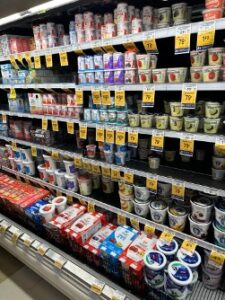
Exhibit B: When member pricing covers an entire aisle, the loyalty program isn’t rewarding members, it’s penalizing everyone else. If everything is on sale, nothing is on sale.
About the Author
Steve Gordon is Managing Director of AlignBiz. He spent years inside the retail analytics world at IBM, building the data systems that grocery loyalty programs were designed to feed. He is a TDWI speaker, creator of Technology Cartography™, and a firm believer that the shelf price should just be the price. He still shops at Safeway. He still types in his phone number. It still doesn’t work.
Steve@align-biz.com | www.align-biz.com